Lawyers’ Fund Awards More Than $80,000 to Clients
Fairfield County
A former client of suspended attorney Jeffrey Dwight Hunter
was determined to be eligible for reimbursement in the
amount of $2,900 as a result of Hunter’s failure to provide the
services requested. Hunter’s license to practice law in Ohio was
suspended for a term beginning on July 9, 2025.
Franklin County
Two former clients of former attorney Elizabeth V. Westfall
were determined to be eligible for reimbursement totaling
$60,284.50 as a result of Westfall’s misappropriation of client
funds. Westfall pled guilty to theft on Sept. 18, 2025, and is
awaiting sentencing. She resigned from the practice of law in Ohio,
with discipline pending, on Dec. 12, 2025.
Hamilton County
A former client of suspended attorney Calvin Sylvester
Tregre Jr. was determined to be eligible for reimbursement
in the amount of $2,800 as a result of Tregre’s failure to provide
the services requested. Tregre’s license to practice law in Ohio was
suspended for a term beginning on Aug. 23, 2024.
Lake County
Former clients of deceased attorney William Charles Behrens
were determined to be eligible for reimbursement of $12,750
as a result of Behrens’s failure to complete the services requested
and failure to provide a refund. Behrens passed away on April 19,
2023.
Montgomery County
A former client of suspended attorney Frank Michael Payson
was determined to be eligible for reimbursement of
$1,273.12 as a result of Payson’s failure to provide the services
requested. Payson’s license to practice law in Ohio was suspended on
July 12, 2024.
Board determinations become final 30 days after the determination unless parties request reconsideration. If reconsideration is granted, the claim will be reviewed by the Board at its next scheduled meeting.
The Lawyers’ Fund for Client Protection, formerly known as the
Clients’ Security Fund, was created in 1985 by the Supreme Court of
Ohio to reimburse victims of attorney theft, embezzlement, or
misappropriation. The LFCP is not taxpayer funded but funded by
registration fees paid by every Ohio attorney. Ohio has over 45,000
attorneys engaged in
The active practice of law. Less than 1% of those attorneys is
involved in claims reimbursed by the LFCP.
Law clients who believe they have sustained financial losses resulting from attorney theft, embezzlement or misappropriation should contact the LFCP by calling 614.387.9390 or 1.800.231.1680 toll free in Ohio.
Chief Justice Encourages Collaboration Among Ohio Clerks
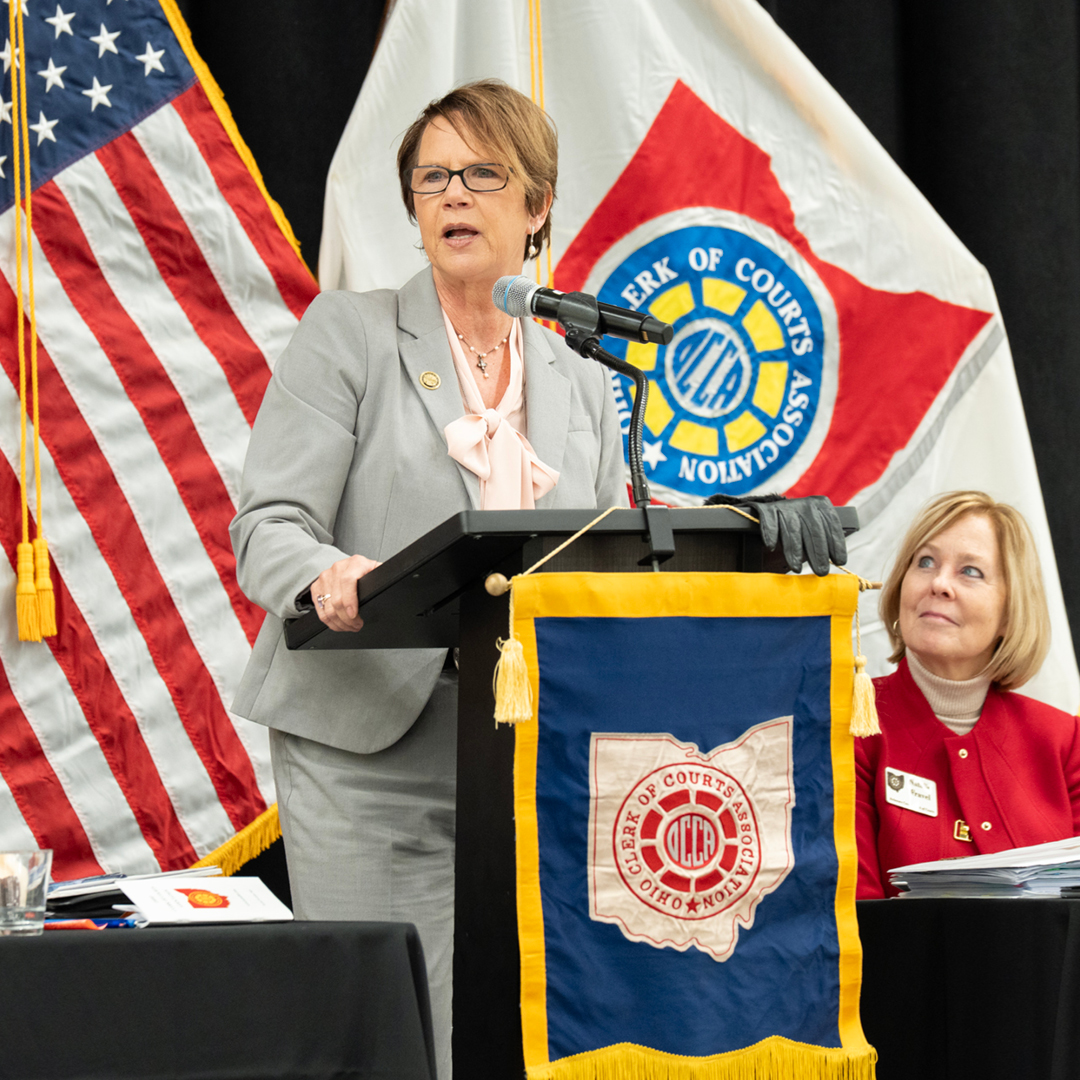
Chief Justice Sharon L. Kennedy spoke at the Ohio Clerk of Courts Association winter conference.
Chief Justice Sharon L. Kennedy was welcomed as a guest speaker at the recent Ohio Clerk of Courts Association winter conference. The conference hosted clerks and staff from nearly every county in Ohio.
Chief Justice Kennedy spoke on her own career experiences in Butler County and on the Supreme Court of Ohio, while commending the service of clerks around the state. She addressed common issues facing both courts and clerks, particularly the common goal of improving BCI disposition reporting.
“Although we come from different worlds, we have shared missions,” said Chief Justice Kennedy. “We need to come together to protect Ohioans.”
Ohio’s clerks of courts act as the official recordkeepers. While their primary duty is to maintain court records, dockets, and files, clerks also collect court costs and issue summons, subpoenas, and arrest warrants. The Ohio Clerk of Courts Association was established in 1940 to assist clerks throughout Ohio.
In her message, Chief Justice Kennedy also emphasized tools available for clerks to carry out their duties more effectively, including services to help with the transition to e-filing. She also noted the importance of collaboration between courts, clerks, and law enforcement.
 PDF files may be viewed, printed, and searched using the free
Acrobat® Reader
PDF files may be viewed, printed, and searched using the free
Acrobat® Reader Acrobat Reader is a trademark of Adobe Systems Incorporated.
Second Round of Public Comment: Proposed Changes to Rules of Superintendence for the Courts of Ohio
This is a second public comment period for Sup.R. 3 through 4.04. One of the newly proposed changes would set a term limit for an administrative judge of a two-judge court or division to six years when the other judge has served as an Ohio judge for six years, except by mutual agreement.
Provide your comments on the proposed amendments in writing no later than Jan. 5, 2026, to:
Keely McWhorter
Supreme Court of Ohio
65 South Front Street
Columbus, Ohio 43215
OR
RuleAmendments@sc.ohio.gov


New Exhibit Celebrates 250 Years of Freedom Through Ohio’s Foundational Documents
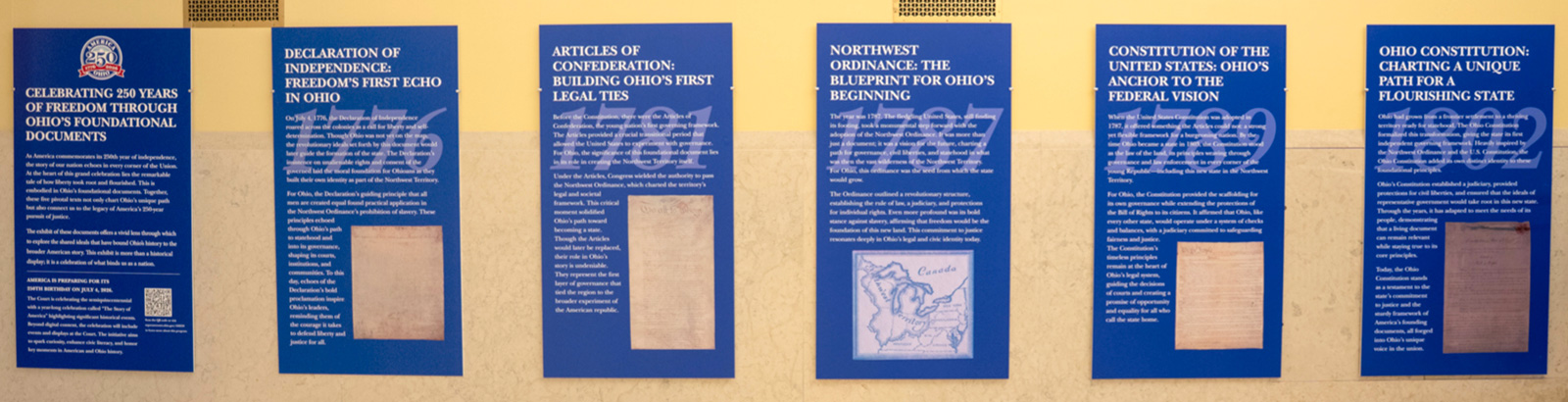
New Exhibit Celebrates 250 Years of Freedom Through Ohio’s Foundational Documents.
The Supreme Court of Ohio continues its America 250 commemoration with a new exhibit, Ohio’s Foundational Documents. Located on the historic ground floor of the Visitor Education Center, this exhibit offers a unique opportunity to explore the pivotal texts that shaped Ohio’s history and its connection to America’s enduring pursuit of liberty and justice.
The exhibit showcases five foundational documents—the Declaration of Independence, the Articles of Confederation, the U.S. Constitution, the Northwest Ordinance, and the Ohio Constitution—each playing a critical role in Ohio’s journey from frontier territory to a thriving state. Through these documents, visitors will gain a deeper understanding of how Ohio’s story intertwines with the broader American narrative, reflecting shared ideals of freedom, equality, and governance.
Visitors will explore the Declaration of Independence’s influence, the Articles of Confederation’s role in creating the Northwest Territory, and the U.S. Constitution’s framework for governance. The exhibit also highlights the Northwest Ordinance’s revolutionary blueprint for statehood and the Ohio Constitution’s unique contributions to the state’s identity.
As America prepares for its 250th anniversary, this
exhibit invites visitors to honor the past while
embracing the values that will guide the next chapter
of Ohio’s and America’s shared history.
This exhibit is one of several featured in the Visitor
Education Center at the Thomas J. Moyer Ohio
Judicial Center. See for yourself on a free tour! Call
614.387.9223 or email CourtTours@sc.ohio.gov to
schedule.

America is preparing for its 250th birthday on July 4, 2026, The Court is celebrating the semiquincentennial with a year-long celebration called “The Story of America" highlighting significant historical events. Beyond digital content, the celebration includes events and displays at the Court. The initiative aims to spark curiosity, enhance civic literacy, and honor key moments in American and Ohio history. supremecourt.ohio.gov/am250

Bringing Hope Home: Franklin County Probate Court Finalizes Eight Adoptions
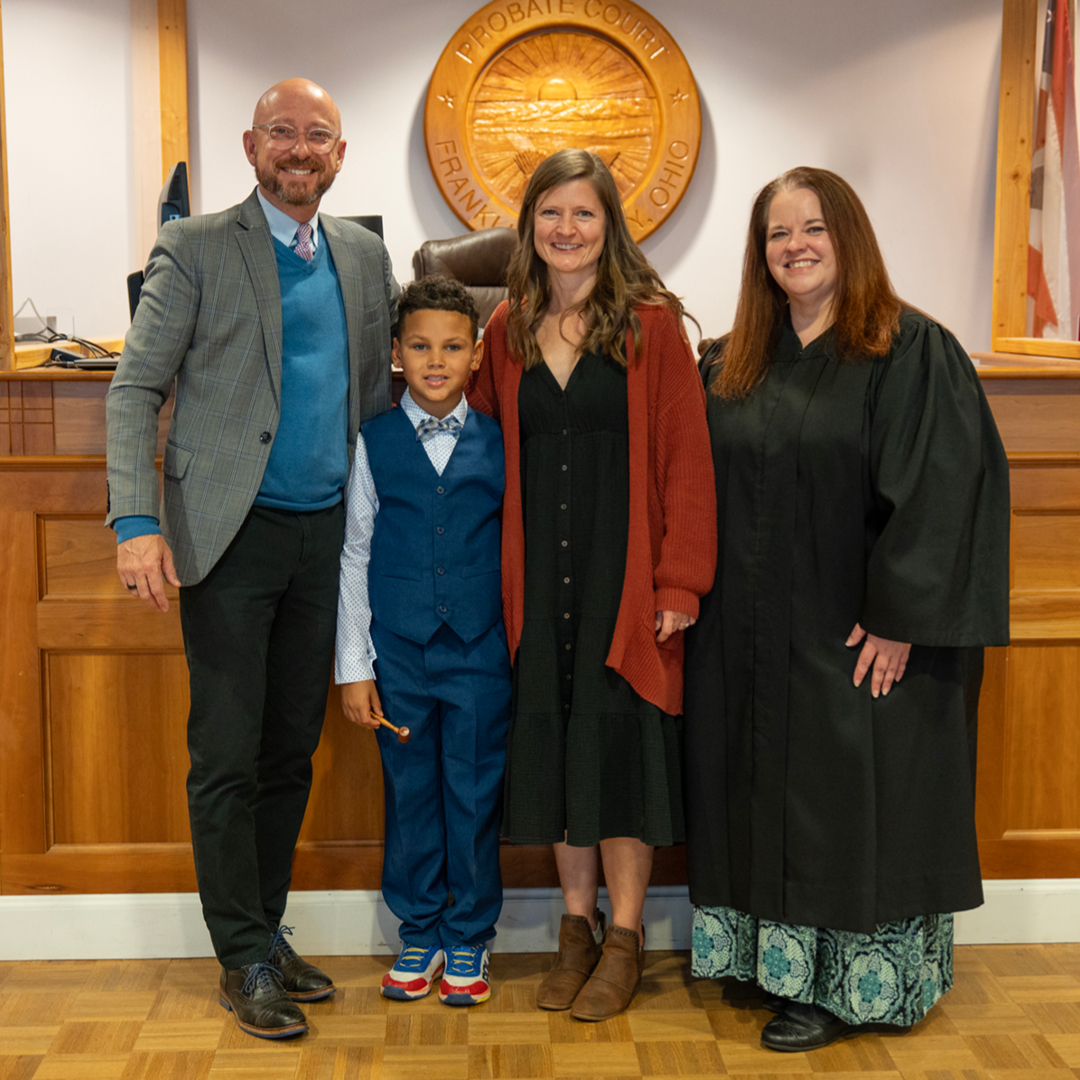
The Arnots celebrate their forever family at the Franklin County Probate Court.
The recent Adoption Day at the Franklin County Probate Court helped finalize the adoptions of eight children and create six new forever families. It was an opportunity to increase awareness and support for children in the foster care system who are waiting for permanent, loving homes.
“Today shines a light on the many children in foster care — especially older youth and sibling groups — who are still waiting for permanent, loving families,” said Chief Magistrate Kelly Green with the probate court. “Today is a reminder of what our community can accomplish when we work together: bringing stability, belonging, and hope to children who deserve nothing less. Our court is honored to celebrate with children as they find their forever homes.”
The Arnots are one of those new families, officially adopting their son Ricky.
“It means forever. We love him so much,” said Jenny Arnot. “This time we get to tell him it’s forever.”
Ricky’s first grade teacher was there for the hearing, and says now that he’s in third grade, Ricky is having a great year and has come so far thanks to stability and people who love and care about him.
“He’s such a different kid than he was in first grade,” said Jocelyn Reedus. “A social butterfly, better behavior, academically his past struggles now come easily.”
Ricky is one of about 125 children to be officially adopted with the support of Franklin County Children Services over the course of a year.
“He shares everything with us. The good, the bad, the ugly,” said Justin Arnot. “We’ll always be here for him and hope he wants to be here with us.”
Ricky couldn’t agree more. “Today is great, because they’re my family.”
Conduct Board Announces December Disciplinary Hearings
Additional case information, including case documents, can be viewed and downloaded by clicking on the case number. Hearings may be continued for good cause at any time. Check the online docket to confirm that a hearing will proceed as scheduled.
December 12, 2025
Lorain County Bar Association v. Anthony Baker
Case No. 2025-014
Relator’s Counsel: Margaret A. O’Bryon, Lorain Cty. Bar Assn.
Respondent’s Counsel: pro se
December 19, 2025 (9 a.m.)
Disciplinary Counsel v. Shawn Alexander Romer
Case No. 2022-035
Relator’s Counsel: Karen H. Osmond, Office of Disciplinary
Counsel
Respondent’s Counsel: pro se
PDF files may be viewed, printed, and searched using the
free
Acrobat® Reader Acrobat Reader is a trademark of Adobe Systems Incorporated.


Settlement Week Solves Conflicts in Franklin County

At Settlement Week in Franklin County, 82% of the mediated cases arrived at a full or partial agreement.
For more than 10 months, two parents in a court case had ongoing disagreements about parenting time, the caregivers for their children, and the children’s medical appointments. The parents also changed attorneys multiple times and took issue with the appointment of a guardian ad litem for their children.
Recently, however, the parents participated in Settlement Week at the Franklin County Domestic Relations and Juvenile Court. During two weeks each year, the court selects cases for mediation or for a pilot program called neutral evaluation. The cases selected are based on recommendations from judges, attorneys, and involved parties with an openness to discussing settlement.
Through the Settlement Week mediation, the parents who were stalled for 10 months resolved several conflicts. They came to an agreement for increasing the parenting time of one parent and decided to use a shared parenting app and calendar to coordinate medical and counseling appointments.
A benefit of the mediations, which are confidential, is giving individuals a chance to directly air their frustrations.
“Settlement Week helps resolve cases by providing an opportunity for parties, and not just their attorneys, to explain why they were seeking a certain outcome and to reflect on what brought them to this point in litigation,” said Karissa Dodge, the court’s dispute resolution department supervisor.
Settlement Weeks in Ohio are managed by courts, which decide which cases are suitable. If the parties agree to participate, the mediator, who is a neutral third party, guides them as they work to resolve their differences. Judge Lasheyl Stroud led the effort to launch Settlement Week in Franklin County Domestic Relations and Juvenile Court in 2021. The court has held Settlement Week twice a year since then.
Settlement Week in Franklin County also encompasses a pilot program for neutral evaluations. Experienced professionals called neutral evaluators assess the strengths and weaknesses of each party’s position. The evaluation helps parties and their attorneys make informed decisions about their case and explore possible resolutions. With both approaches, mediators and neutral evaluators offer reduced costs for their services than would be available in private sessions.
At this fall’s Settlement Week in Franklin County, 27 mediations and 17 neutral evaluations were held. As a result of the efforts, 82% of the cases mediated reached a full or partial agreement on their issues, and 60% of the neutral evaluations arrived at complete or partial resolutions.
Another success story involved a seven-month dispute between the parents of three children. Because of the agreements the parents reached at Settlement Week, the children will avoid in camera interviews with a judge in anticipation of a trial.
“The discussions often helped parties identify moments where communication breakdowns or misaligned expectations had fueled ongoing conflict,” Dodge explained. “These conversations encouraged families to explore additional supports, such as parenting coordinators, counseling for the children or parents, or other alternatives.”
Surveys of the participants in Franklin County reveal the value of Settlement Week.
One wrote, “I did not think it would help, but some issues are actually moving towards resolution.”
“We had an excellent mediator that I would 100% work with again,” another said. “She was very solution oriented and helped keep tensions between us in check.”
Courts also benefit. Several Ohio courts that have implemented Settlement Weeks have reduced the number of civil cases on their dockets. Along with lowering the caseloads and resolving disputes across the state, Settlement Week enables courts to focus on other complicated cases that require trials.
More Than 600 New Lawyers Ready to Serve Communities
Family members joined Vicki Heiser to celebrate her swearing in. She will operate a general practice with her new law license.
Ohio welcomed 615 new attorneys to the practice of law during the November Bar Admission Ceremony and recognized them for their achievements.
“This has been the culmination of 20 years or more of formal education, and your education will continue every day of your professional life,” said Supreme Court of Ohio Chief Justice Sharon L. Kennedy. “But today, it is a moment to celebrate this milestone, the sacrifices, and the accomplishments for you, your family, and all who have supported you along your journey to this point.”
Vicki Heiser of Marion marked the occasion with her husband, son, grandchildren, and extended family.
Before law school, Heiser spent 13 years working as a paralegal for her husband, Larry. But when he was elected judge on the Marion County Family Court, she had to leave that role.
“I decided to go to law school and do it myself,” she said.
She drove an hour each way, every day to Ohio Northern University Pettit School of Law, all while maintaining her paralegal career and raising her grandson, Gabriel.
“I think she’s incredible,” said Judge Heiser of his wife. “She’s worked really hard, and she’s going to be a great attorney.”
Eager to begin her own general practice, Vicki Heiser had meetings with potential clients scheduled for the day after she was sworn in.
“Just do it,” said Heiser to anyone considering law school. “If it’s what you want to do, do it. Don’t let fear stop you.”
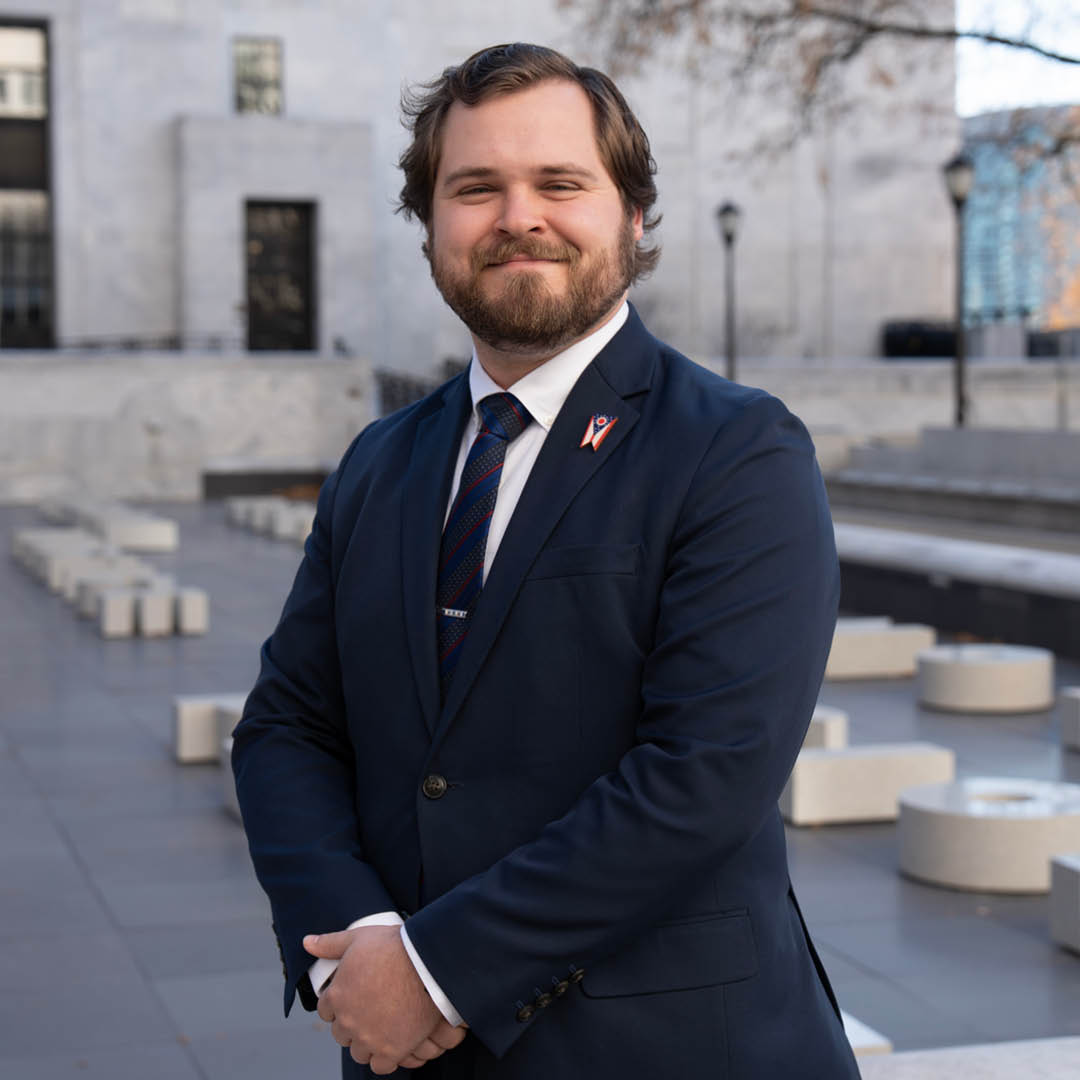
Cameron Wene is using the skills he learned during his externship at the Supreme Court of Ohio to analyze arguments in his new role as an assistant prosecutor.
Overcoming the Challenges of Law School
For Cameron Wene, becoming an attorney has been eight years in
the making. A recent graduate of Capital University Law School,
Wene knew in high school that he wanted to use his skills to
serve his community through a career in public service. He also
wanted to understand the law and how to use it, so becoming an
attorney was the logical choice.
“Law school is one of the most difficult things, if not the most difficult thing, that I think people can go through, education-wise,” said Wene.
Through Capital University’s 3 + 3 Bachelor-to-Law program, Wene began law school while still completing his undergraduate degree. It meant taking the LSAT a year early, sacrificing the typical senior-year college experience, and becoming one of the youngest students in his cohort.
“Not having that extra year meant I had to work harder. I had to do better. I had to prove to myself that I was in the right space,” he said. “I'm not one to say that I needed to prove to others that I could do it. I just needed to reassure myself that I was doing what I thought I was called to do.”
In addition to classes, Wene also took on several internships and externships, including one at the Supreme Court of Ohio with Justice F. Patrick DeWine. Through that experience, he learned to review cases and petitions, ensure the accuracy of citations, and write memos on whether cases are appropriate to accept on appeal. Wene also researched the nuances between the Ohio Constitution and the U.S. Constitution.
While buried in countless hours of reading assignments, research, and paper writing, Wene watched as his friends moved on with careers and marriages. He said it was definitely difficult at times.
It was a sigh of relief the day the bar exam results were released, and he saw his name on the list.
“It was a rush of so many different emotions of gratification and a release of anxiety and relief,” Wene said. “I always think of the comments that are made at weddings, like, ‘Oh, it's the next chapter of their life.’ That's kind of what it feels like.”
The Beginning of a Lifelong Commitment
While the day was a celebration, it also marked the beginning of
a career that requires more hard work, diligence, preparation,
and attention to detail to succeed. Justice DeWine reminded the
newly sworn attorneys that the oaths they took weren’t just a
formality, but a lifelong commitment to the principles embodied
in the Ohio and the U.S. constitutions.
“People turn to lawyers when they're at their most vulnerable. It may be a business struggling to get off the ground, a kid who doesn't want one mistake to ruin his or her life, a family dealing with divorce, or maybe someone who just needs their voice heard,” said Justice DeWine. “They look to us for dispassionate advice, for a clear understanding of the rules, and for scrupulous attention to detail. Take that responsibility seriously.”
Wene is learning this message firsthand as he begins his role as a juvenile prosecutor in Delaware County.
“In law school, one of the things they tell us is that lawyers are called counselors, because no matter what kind of law you do, you're interacting with someone on, usually, one of the worst days of their lives,” said Wene. “Seeing some of the things that kids go through puts it in perspective that bad things don't just happen to adults. I’m in a role where I not only get to advocate on behalf of victims in the community, but I also help try and get kids the resources they need.”
He is also learning to put the skills from his externship to use at his new job.
“The Supreme Court externship really helped me see the different ways to organize arguments. Now that I am in front of judges and magistrates, it’s really helped me see how I can formulate my argument to make the best legal sense, as well as to be persuasive,” said Wene.
He has also learned how to understand, evaluate, and anticipate what arguments the other side is formulating.
Justice DeWine noted at the ceremony that the skills to argue civilly are essential in the legal profession but also extend beyond the practice of law.
“Your legal training is a rare gift: The ability to disagree without being disagreeable, in a world that prizes sound bites of polarization. Lawyers are trained to build bridges between opposing views,” said Justice DeWine. “Be the architects of civil discourse. Use your legal skills to foster a true marketplace of ideas, not just in your practice, but in your community, to promote respectful and open debates.”
Supreme Court Showcases Reentry Resources for Employment
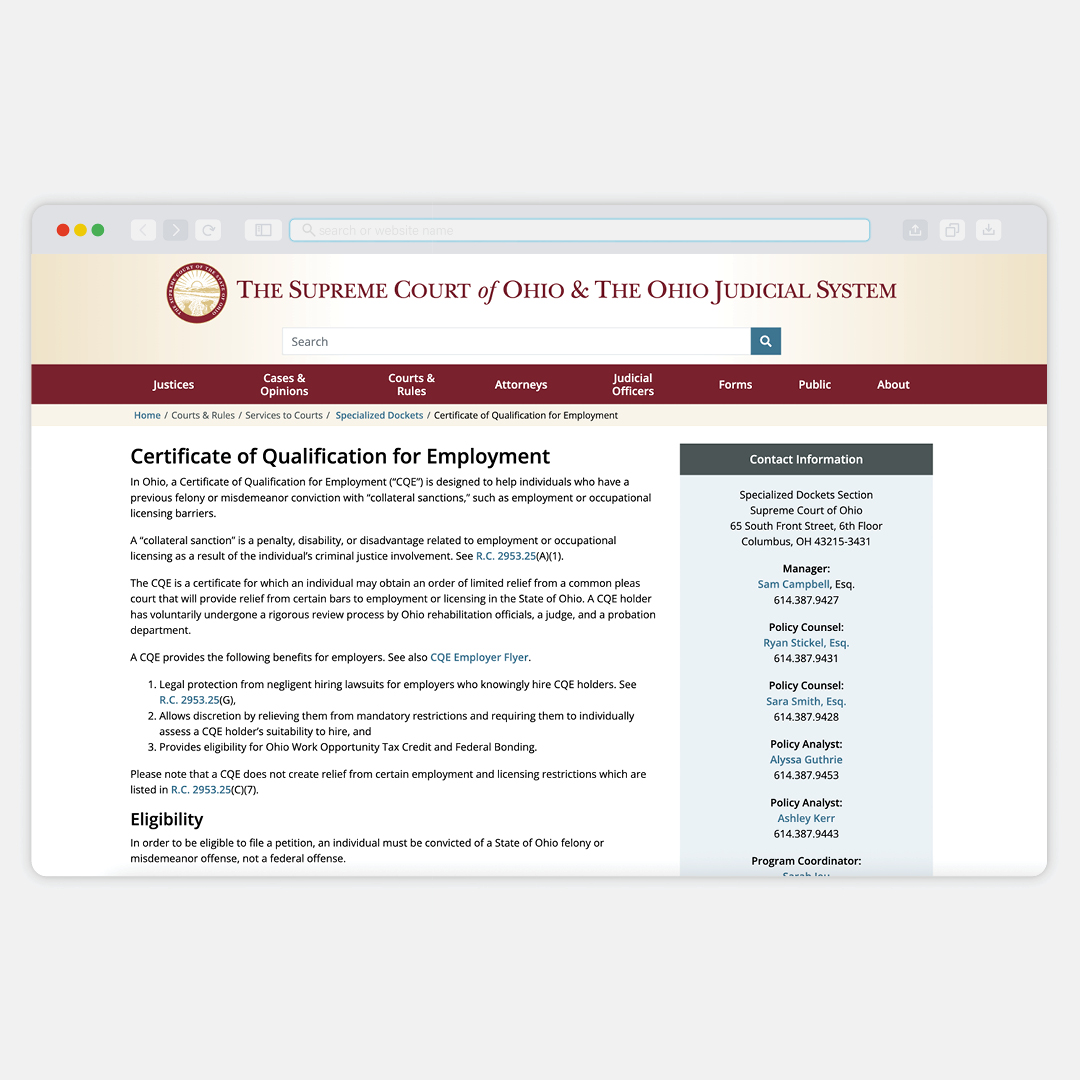
The Supreme Court recently launched a new webpage with resources on certificates of qualification for employment.
The Supreme Court of Ohio recently unveiled a new webpage compiling available resources for individuals seeking relief from employment restrictions due to past criminal charges.
Certificates of qualification for employment (CQE) are issued by common pleas courts to individuals with state misdemeanor or felony convictions for permission to hold employment or obtain professional licenses in the state. To qualify for a CQE, individuals undergo a broad review by the court, which may require additional information from the individual and other criminal justice professionals before they reach a decision.
Individuals interested in obtaining a CQE must file a petition with the Ohio Department of Rehabilitation and Correction (ODRC) after a mandatory waiting period based on their conviction. After ODRC’s initial approval, the individual can then file a CQE petition with their county’s common pleas court. From there, courts review the petition, prior convictions, prior military service, and other evidence and filings from the petitioner.
While not all types of convictions are eligible for a CQE, those who are granted a certificate demonstrate that their prior conviction shouldn’t outright exclude them from obtaining employment or a license in Ohio.
Employers also benefit from hiring individuals who have a CQE. From legal protections for potential negligent hiring lawsuits to tax credit and federal bond eligibility, employers can learn more from the Supreme Court resource about hiring an individual with a CQE.
CQEs are one of many reentry services provided by the ODRC. Through services such as lowering the barriers for employment, the ODRC hopes to facilitate successful reintegration for previous offenders.